Trip.com Group Reinforces AI Innovation and European Collaboration at ITB Berlin
- 60% of interactions with the Group's AI Assistant (TripGenie) are now related to booking decisions
- TripGenie's AI-assisted features see 300% year-over-year increase
- Trip.com Group welcomes senior delegation of policymakers and tourism leaders
BERLIN, March 4, 2026 /PRNewswire/ -- Trip.com Group concluded its participation at ITB Berlin with strong demonstrations of its leadership in travel technology, artificial intelligence and strategic partnerships across Europe. At a series of panel discussions, the company shared insights into how innovation and data are reshaping traveller behaviour and partner opportunities, underscoring its commitment to powering the full travel journey from trip planning to in-trip support and beyond.
Trip.com Group's presence at ITB Berlin emphasised how the future of travel is being redefined by digital integration and smart technology.
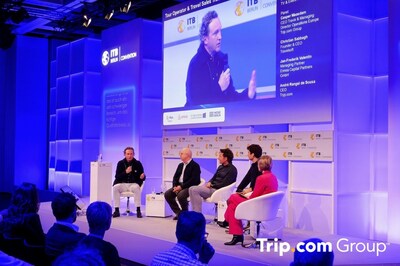
Casper Maasdam, Managing Director Europe, Operations at Trip.com Group, joined panel 'The Critical Success Factors in a Data- and AI-driven Sales World', to explore how predictive AI models are transforming travel commerce by anticipating demand and powering context-aware offers. At the heart of this transformation is AI's ability to go beyond mere suggestions to enable active, agentic commerce, helping customers complete transactions faster and with greater relevance. He shared compelling data on the Group's AI Assistant, TripGenie, including a 400% year-over-year increase in AI-assisted bookings and a 300% increase in adoption of real-time AI features, such as live translation and menu assistant. Maasdam also reflected on distinct regional behaviours, noting that in parts of Asia, travellers rely more on last-minute, real-time guidance, while in European markets such as Germany and the UK, there is a greater focus on early planning and risk reduction, reinforcing the importance of locally informed innovations.
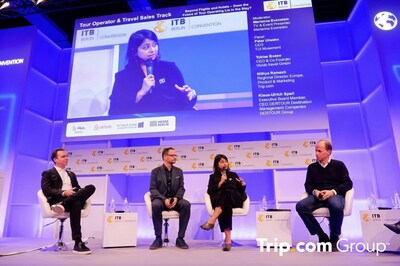
Nithya Ramesh, Regional Director at Trip.com Group, participated in a second session, 'Beyond Flights and Hotels – Does the Future of Tour Operating Lie in the Stay?'. She outlined the company's vision for digitally powering the stay by connecting travellers with a comprehensive ecosystem of services and experiences. Ramesh further highlighted that value capture within travel is evolving, noting that travellers increasingly seek certainty and risk reduction before arrival, a trend reflected in digital engagement. A substantial 60% of interactions with TripGenie are now related to booking decisions, demonstrating how digital tools are becoming essential to traveller confidence and conversion.
Building on AI travel, Ramesh also led Trip.com Group's AI Guided Tour at ITB, where the company was recognised as an ITB Innovator 2026 for its Trip.Planner solution. Designed as an all-in-one itinerary hub, it collapses the traditional multi-app planning journey into a single, bookable architecture powered by real-time pricing and verified partner data. Behind the interface, Trip.Planner hub analyses user preferences, retrieves millions of data points and optimises routes to ensure itineraries are not only personalised but physically and logistically viable. The tool combines flexible editing, style-based personalisation and expert human vetting, reinforcing a critical trust layer in AI-driven travel.
Edison Chen, Vice President at Trip.com Group, further welcomed a senior delegation of policymakers and tourism leaders as part of the official ITB Berlin opening programme, offering an opportunity for strategic engagement and visibility among stakeholders. This exchange underscored Trip.com Group's commitment to maintaining strong relationships with European policy and industry leaders as part of its broader collaboration strategy.
Throughout ITB Berlin, Trip.com Group's contributions reinforced the central role of AI, innovation and cross-sector partnerships in shaping the travel industry's next chapter. By connecting travellers to a digitally empowered ecosystem and equipping partners with forward-looking insights, the company continues to define innovative ways to build confidence, personalise experiences and drive growth in the global travel landscape.
About Trip.com Group
Trip.com Group is a global travel service provider comprising of Trip.com, Ctrip, Skyscanner, and Qunar. Across its platforms, Trip.com Group helps travellers around the world make informed and cost-effective bookings for travel products and services and enables partners to connect their offerings with users through the aggregation of travel-related content and resources, and an advanced transaction platform consisting of apps, websites and 24/7 customer service centres. Founded in 1999 and listed on NASDAQ in 2003 and HKEX in 2021, Trip.com Group is on the mission "to pursue the perfect trip for a better world". Find out more about Trip.com Group here: group.trip.com.
Follow us on: X, Facebook, LinkedIn, and YouTube.

Photo - https://mma.prnewswire.com/media/2925915/image_5004521_42076972.jpg
Photo - https://mma.prnewswire.com/media/2925916/1.jpg
Logo - https://mma.prnewswire.com/media/2919909/Trip_com_Group_Logo.jpg
 View original content:https://www.prnewswire.co.uk/news-releases/tripcom-group-reinforces-ai-innovation-and-european-collaboration-at-itb-berlin-302704121.html