Smartee Deepens European Footprint and Showcases Integrated Mandibular Advancement Repositioning Technology at ALIGNEA 2026
SALAMANCA, Spain, March 5, 2026 /PRNewswire/ -- Smartee Denti-Technology, a global innovator in clear aligner solutions, reinforced its commitment to the European market at the 11th International Congress of Aligners (ALIGNEA) held in Salamanca from February 19-21. Beyond showcasing the evolved clinical applications of its proprietary Mandibular Repositioning Technology, the company highlighted its strengthened regional infrastructure, now anchored by manufacturing and clinical support hubs in Spain and the UK.
A Distinctive Presence: Humanizing Orthodontics through Pop Culture
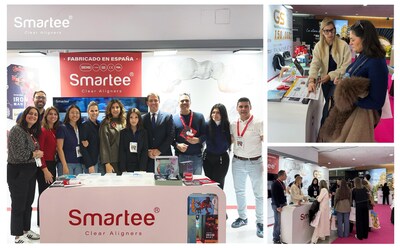
Smartee's exhibition booth drew significant attention from industry peers, standing out as a unique presence on the congress floor. The design featured officially licensed Marvel Iron Man visual elements, a creative move that broke the traditional "cold" and purely clinical stereotype of orthodontic practice.
By integrating popular culture with professional medical solutions, Smartee successfully infused warmth and energy into the doctor-patient dialogue. This fresh approach not only attracted the gaze of global experts but also demonstrated a novel way to bridge the emotional gap between clinicians and adolescent patients, utilizing positive psychological reinforcement to encourage consistent appliance wear.
Clinical Excellence on the Main Stage
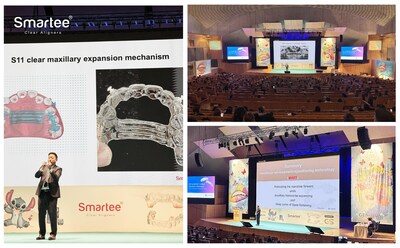
Dr. Te Wang, a core member of Prof. Gang Shen's Orthodontic Team from Shanghai TaiKang Dental Hospital, was invited to deliver a keynote presentation at the congress main stage on February 20. His lecture, titled "A Novel Clear S8-SGTB Correcting Severe Class II Jaw Discrepancy by Mandibular Repositioning Technology," addressed one of the most persistent challenges in orthodontics: skeletal Class II malocclusions.
Dr. Wang explained that these discrepancies often stem from maxillary overgrowth combined with mandibular retrusion, resulting in convex facial profiles. Traditionally, treatment options for Class II cases were largely limited to orthodontic camouflage with premolar extractions, or in severe cases, orthognathic surgery to correct the underlying skeletal discrepancy.
The lecture demonstrated how the Smartee S8-SGTB clear aligner enables simultaneous orthopedic and orthodontic corrections. The repositioning of the mandible forward induces condylar adaptation while the dentition is being aligned, which offers patients a non-invasive pathway to improved facial balance and occlusal function.
Beyond Orthodontics: Sleep Aligners
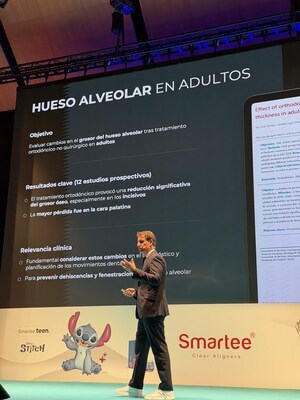
Expanding the scope of clear aligner therapy, Smartee hosted a specialized workshop titled "Optimization of Mandibular Repositioning and Sleep Apnea Treatment in Adolescents and Adults Using Advanced Appliances." Co-lectured by Dr. Te Wang alongside Spanish clinicians Dr. María del Carmen Pérez and Dr. María del Pilar Pérez, the session explored the intersection of orthodontics and sleep apnea treatment. The workshop provided practical insights into using mandibular advancement to manage Sleep-Disordered Breathing, marking a shift towards a multidisciplinary, health-oriented approach to dental care.
Strategic Localization: Manufacturing & Clinical Support
Smartee's participation at ALIGNEA 2026 underscores a broader strategy of European localization.
The company established its Madrid manufacturing hub in 2024, serving as a strategic base for pan-European expansion . This facility enables localized production, faster service delivery, and solutions tailored to European clinical needs.
In October 2025, Smartee further strengthened its European infrastructure by inaugurating its UK subsidiary and European Orthodontic Clinical Support Center in Stoke-on-Trent , it provides orthodontic treatment planning services, case analysis, and technical support. It ensures strict adherence to European data protection regulations and clinical standards while fostering collaborative partnerships with local academic institutions to advance joint research.
With dual manufacturing capabilities in China and Spain, Smartee now serves a network of over 99,000 partner doctors across 57 countries worldwide, delivering precise, evidence-based orthodontic solutions and clear aligners treatment worldwide.
Photo - https://mma.prnewswire.com/media/2925871/Smartee_Denti_Technology_11th_International_Congress_Aligners__ALIGNEA__2026.jpg
Photo - https://mma.prnewswire.com/media/2925872/Dr_Te_Wang_invited_deliver_a_keynote_presentation_congress_main.jpg
Photo - https://mma.prnewswire.com/media/2925873/image_5022954_35514311.jpg
 View original content:https://www.prnewswire.co.uk/news-releases/smartee-deepens-european-footprint-and-showcases-integrated-mandibular-advancement-repositioning-technology-at-alignea-2026-302704795.html