OMRON Charts Data-Driven Path to 2030 for European Business
Medium-term plan emphasizes "Trusted Growth", "GEMBA DX", and portfolio restructuring, positioning Europe as one of the focus regions in OMRON's global transformation strategy.
KYOTO, Japan, March 11, 2026 /PRNewswire/ -- OMRON Corporation (TSE: 6645), recently announced its medium-term roadmap, Shaping the Future 2030 (SF2030) 2nd Stage, outlining a strategic path to return to sustainable growth led by devices and transform into a data-driven "GEMBA DX (on-site digital transformation) company." Covering the period through 2030, the plan combines offensive investments in 13 focus businesses with defensive structural reforms to rebuild the company's portfolio and strengthen execution capability.
"Trusted Growth reflects our strong desire to deepen the relationship of trust with our customers and once again achieve strong growth in order to transform ourselves into GEMBA DX company," said Junta Tsujinaga, President & CEO, OMRON Corporation. "GEMBA DX fuses and multiplies high-quality data obtained from devices, which is one of OMRON's strengths, with other data from the field, utilizing knowledge to convert this data into something of value. We aim to use this data to provide data services that solve our clients' essential problems."
Key Strategic Pillars of SF2030 2nd Stage
- Rebuilding the Business Portfolio
OMRON has designated 13 focus businesses (mainly Industrial Automation) — including Controllers, Sensors, and Blood Pressure Monitors, alongside data service businesses such as Industrial Automation (IA) Data Solution and Digital Health — as growth drivers. By 2030, approximately 70% of investments will be directed toward these areas. - Transformation into a GEMBA DX Company
To become a Gemba DX company, OMRON will leverage its three core strengths: a globally deployed portfolio of high-market-share devices; deep customer insights and data from on-site collaboration with customers; and proprietary technology that transforms this data into actionable, value-creating intelligence.
Europe as a Focus Region
- Industrial Automation: OMRON targets a Revenue CAGR of +8.0% through FY2030. Key drivers include the introduction of advanced IA Data Solutions and a virtual control platform for European multinational corporations, enabling them to optimize production globally.
As per Fernando Colás, CEO, OMRON Industrial Automation Europe, "UK manufacturers are under increasing pressure to improve productivity while managing skilled labour shortages and operational complexity. By combining our automation technologies with strong local expertise, we help customers move from fragmented automation toward more autonomous and efficient operations, in a practical, scalable way."
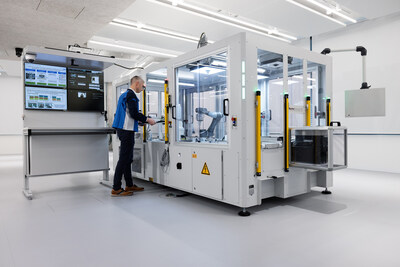
OMRON is reinforcing its support for UK manufacturers through local expertise and education services. By combining application engineering, training programs, and on-site support, OMRON helps customers strengthen internal capabilities and adopt automation technologies that address skills gaps, while implementing scalable automation solutions more effectively.
The company also aims to recover and expand its share among machine builders in strategic markets such as Italy and Spain by offering various devices and tailored automation solutions.
- Healthcare: OMRON is targeting to significantly outperform the market by leveraging its strengths in medical endorsements, product accuracy, and strong brand equity.

Photo - https://mma.prnewswire.com/media/2930241/OMRON_DE_and_UK_Image.jpg
Logo - https://mma.prnewswire.com/media/2803499/5855560/OMRON_Logo.jpg
 View original content:https://www.prnewswire.co.uk/news-releases/omron-charts-data-driven-path-to-2030-for-european-business-302710488.html