MIDDLE EAST WAR DRIVES GLOBAL SUPPLY CHAIN PRESSURES TO A THREE-YEAR HIGH: GEP GLOBAL SUPPLY CHAIN VOLATILITY INDEX
- Supply shocks drive manufacturers' stockpiling, push shortages to a three-year high and transport costs to a four-year peak
- Asia reports weaker demand and soaring transport costs
- Cost pressures build in North America as demand remains soft
- European manufacturers safety-stockpile the most aggressively
CLARK, N.J., April 10, 2026 /PRNewswire/ -- GEP Global Supply Chain Volatility Index — a leading indicator tracking demand conditions, shortages, transportation costs, inventories and backlogs, based on a monthly survey of 27,000 businesses — signaled that global supply chain pressures rose to a three-year high in March, reflecting the immediate economic impact of the energy price shock and maritime disruption caused by the war in the Middle East.
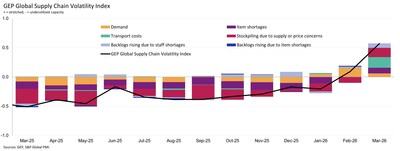
The GEP Global Supply Chain Volatility Index soared from 0.09 in February to 0.57 in March, its highest level since January 2023.
In March, global manufacturers increase safety stockpiling in response to maritime disruption, higher transportation costs and supplier price increases. Reports of inventory buffers being accumulated were the highest in three years, with increases across all major regions.
Uncertainty resulting from the conflict weighed on manufacturers' input demand, with factories around the world cutting purchasing volumes. Notably, item shortages hit a three-year high despite slowing demand, signaling the emergence of bottlenecks, with the availability of materials such as polymers, PVC and rubber, as well as energy-intensive metals such as aluminum and copper reportedly deteriorating the most.
Surging oil prices pushed global transportation costs to a four-year high in March. The impact was felt globally, but especially strongly in Asia, given its reliance on Middle East oil. Taiwan, Vietnam, South Korea and Japan reported surging producer price inflation during March.
"The war is pushing up costs, triggering stockpiling and creating shortages across supply chains, but it has not yet escalated into a broad-based shock that materially slows global economic growth," said Mukund Acharya, vice president, consulting, GEP. "Companies need to secure supply where it matters most while avoiding broad stockpiling that can lock in higher costs."
Interpreting the data:
Index > 0, supply chain capacity is being stretched. The further above 0, the more stretched supply chains are.
Index < 0, supply chain capacity is being underutilized. The further below 0, the more underutilized supply chains are.
Interpreting the data:
Index > 0, supply chain capacity is being stretched. The further above 0, the more stretched supply chains are.
Index < 0, supply chain capacity is being underutilized. The further below 0, the more underutilized supply chains are.
MARCH 2026 REGIONAL KEY FINDINGS
- ASIA: Index jumps to 1.16, from 0.40, the highest since August 2022, signaling significant supply chain pressures for Asian manufacturers.
- NORTH AMERICA: Index rises from -0.26, a level consistent with spare capacity, to 0.42 – a 39-month high and signaling the strongest degree of pressure on North America's supply chains since December 2022.
- EUROPE: Index increases to 0.64, from 0.05, highlighting the most intense pressure on Europe's supply chains since January 2023.
- U.K.: Index ticks up to 0.16, from -0.01, pointing to the emergence of supply bottlenecks across the U.K.
MARCH 2026 KEY FINDINGS
- DEMAND: After rising to its strongest level in four years in February, the global input demand indicator – which tracks purchases of raw materials and intermediate goods by factories – weakened in March, signaling a tapering of worldwide manufacturing buying activity. This was principally led by a pick-up in retrenchment across Asia as purchasing picked up slightly in North America and Europe, reflecting stockpiling here ahead of further anticipated price rises and supply chain disruption.
- INVENTORIES: Reports of stockpiling due to price or supply concerns shot up to their most prevalent in three years during March. Whilst greater inventory building was witnessed in all major markets, it was Europe where reports were their most common.
- MATERIAL SHORTAGES: The items in short supply tracker rose sharply in March, signalling an immediate emergence of bottlenecks across global supply chains following the outbreak of war in the Middle East. According to the measure, businesses reporting item shortages were their greatest since April 2023.
- LABOR SHORTAGES: Reports of backlogs accumulating due to inadequate labor supply ticked up to a three-month high in March and were slightly above the historical average.
- TRANSPORTATION: The oil price shock caused by the war in the Middle East sent global transportation costs surging in March, rising to the highest level in nearly four years.
For more information, visit www.gep.com/volatility.
Note: Full historical data dating back to January 2005 is available for subscription. Please contact economics@spglobal.com.
The next release of the GEP Global Supply Chain Volatility Index will be 8 a.m. ET, May 12, 2026.
About the GEP Global Supply Chain Volatility Index
The GEP Global Supply Chain Volatility Index is produced by S&P Global and GEP. It is derived from S&P Global's PMI® surveys, sent to companies in over 40 countries, totaling around 27,000 companies. The headline figure is a weighted sum of six sub-indices derived from PMI data, PMI Comments Trackers and PMI Commodity Price & Supply Indicators compiled by S&P Global.
- A value above 0 indicates that supply chain capacity is being stretched and supply chain volatility is increasing. The further above 0, the greater the extent to which capacity is being stretched.
- A value below 0 indicates that supply chain capacity is being underutilized, reducing supply chain volatility. The further below 0, the greater the extent to which capacity is being underutilized.
A Supply Chain Volatility Index is also published at a regional level for Europe, Asia, North America and the U.K. For more information about the methodology, click here.
Media Contacts
Derek Creevey | Joe Hayes | S&P Global Market Intelligence |
Director, Public Relations | Principal Economist | Corporate Communications |
GEP | S&P Global Market Intelligence | Email: Press.mi@spglobal.com |
Phone: +1 646-276-4579 | Phone: +44-1344-328-099 | |
Email: derek.creevey@gep.com | Email: joe.hayes@spglobal.com |
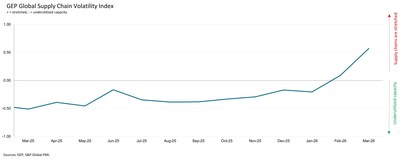
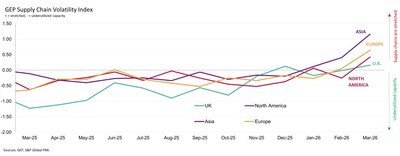

Photo - https://mma.prnewswire.com/media/2953258/GEP_SCVI_breakdown.jpg
Photo - https://mma.prnewswire.com/media/2953259/GEP_SCVI_headline.jpg
Photo - https://mma.prnewswire.com/media/2953260/SCVI_ALL.jpg
Logo - https://mma.prnewswire.com/media/518346/GEP_Logo.jpg
 View original content:https://www.prnewswire.co.uk/news-releases/middle-east-war-drives-global-supply-chain-pressures-to-a-three-year-high-gep-global-supply-chain-volatility-index-302738828.html