Binance Unveils the Next Evolution of Capital Connect: Now Built on Portfolio Accounts Infrastructure to Improve Institutional Crypto Investment Discovery
Enhanced technology solution combines front-end discovery with back-end omnibus account infrastructure to reduce fragmentation in crypto asset investment
ABU DHABI, UAE, April 8, 2026 /PRNewswire/ -- Binance today announced the reintroduced Capital Connect, its marketplace platform for eligible institutional users, now built on top of Portfolio Accounts, Binance's institutional account infrastructure solution for portfolio investment.
Originally launched to bridge information and networking gaps between investors and trading teams, the first-of-its-kind Capital Connect now delivers a more integrated experience by combining front-end portfolio discovery with the back-end operational infrastructure of Portfolio Accounts. Together, these solutions reduce fragmentation in crypto asset investment and provide a more structured way for eligible participants to connect via Binance's technology platform.
In a market where crypto allocation remains fragmented and communication often relies on informal, opaque channels, Capital Connect improves transparency, trust, and operational efficiency for investors seeking to access trading teams.
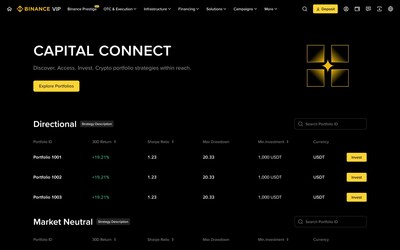
Under the updated model, trading teams onboard to Portfolio Accounts, where they can run strategies and establish a track record before becoming discoverable on Capital Connect. Institutional investors can browse portfolio information and express interest through the platform. During the initial stage, both sides remain anonymous. If a trading team accepts a connection request, the investor receives the trading team's information while remaining anonymous.
Investors can search, filter, and compare strategies by:
- Strategy type (e.g. Market Neutral, Directional, Statistical Arbitrage)
- Performance (30-day return, return since inception, NAV per allocation)
- Risk metrics (Sharpe ratio and maximum drawdown)
- Terms (minimum investment, currency, fees, lock-up period, settlement window)
Portfolio Accounts provide the underlying omnibus account infrastructure that enables trading teams to pool and manage assets in one or more accounts based on their preferred trading strategies. Modeled on traditional finance, Portfolio Accounts offer trading teams greater operational efficiency while giving investors a structured process to allocate and redeem investments, with added confidence that assets remain securely held on Binance and cannot be withdrawn by the trading teams. Any trading decisions made through the platform remain between the participants themselves.
Catherine Chen, Head of Binance VIP & Institutional, said: "With Capital Connect now rebuilt on top of Portfolio Accounts, we're bringing a more integrated and scalable way for investors and trading teams to meet and work together. Capital Connect is another milestone in our journey to reduce friction in crypto market infrastructure and make digital assets more accessible for institutional and sophisticated users."
Key features of the updated Capital Connect include:
- More structured discovery: Eligible investors can browse portfolio information through a standardized platform experience, reducing reliance on fragmented introductions and informal market channels.
- Integrated account infrastructure: Trading teams operate through omnibus account infrastructure designed to streamline operations and support scalable strategy execution.
- Track record visibility: Trading teams establish an operating history through Portfolio Accounts before becoming visible on Capital Connect.
- Privacy protections: Investors and trading teams remain anonymous during the initial interaction stage to help protect user information.
- Institutional onboarding standards: Participation is limited to eligible Binance VIP & Institutional users who have completed relevant KYB verification requirements.
- TradFi-inspired infrastructure: Portfolio Accounts bring operating models familiar to traditional finance participants into the digital asset ecosystem.
Availability: Capital Connect is available to eligible institutional users who have completed applicable KYB onboarding requirements, subject to regional restrictions. Trading teams are subject to holding a valid licence (or recognised exemption) issued by a regulatory authority in their jurisdiction to provide investment, portfolio or asset management activities to access Capital Connect. Investors must meet one of the following financial criteria to access Capital Connect: VIP 3 status or above, $1M or more in total assets on Binance, or submission of external asset proof equivalent to $1M for review. Institutional investors and trading teams can contact their Binance Institutional representative or apply through official Binance channels.
Disclaimer: Capital Connect is a connection and facilitation service presented on an "as is" and "as available" basis without representation or warranty of any kind. This service is only accessible to qualified persons and may not be available in your region. Binance is not liable or responsible for the completeness or accuracy of any information regarding any Trading Team presented here. No information presented on or through Capital Connect should be construed as financial advice, a personal recommendation, or an offer or solicitation to buy or sell any investment. For more information, see our Terms of Use and Risk Warning.
About Binance
Binance is a leading global blockchain ecosystem behind the world's largest cryptocurrency exchange by trading volume and registered users. Binance is trusted by more than 310 million people in 100+ countries for its industry-leading security, transparency, trading engine speed, protections for investors, and unmatched portfolio of digital asset products and offerings from trading and finance to education, research, social good, payments, institutional services, and Web3 features. Binance is devoted to building an inclusive crypto ecosystem to increase the freedom of money and financial access for people around the world with crypto as the fundamental means. For more information, visit: https://www.binance.com.
About Binance VIP & Institutional
Binance VIP & Institutional empowers institutions and private wealth clients with robust asset management infrastructure, personalized VIP services and advanced end-to-end institutional trading tools on the world's largest cryptocurrency exchange by trading volume and registered users. With deep financial services experience in both traditional and crypto markets, its global team of trusted experts provides VIP & Institutional clients with the support they need to confidently capitalize on the industry's deepest liquidity and tightest markets.
For more information, visit: https://www.binanceinstitutional.com
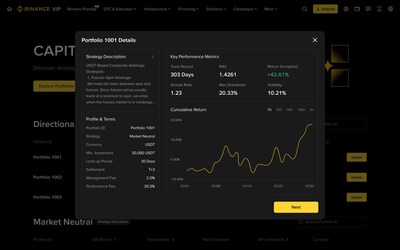

Photo - https://mma.prnewswire.com/media/2951976/Capital_Connect_helps_address_fragmentation_limited_visibility_networking_inefficiencies_crypto.jpg
Photo - https://mma.prnewswire.com/media/2951977/Trading_teams_onboard_Portfolio_Accounts_operate_strategies_establish_a_track.jpg
Logo - https://mma.prnewswire.com/media/1773650/Binance_Logo_Yellow_4x_Logo.jpg
 View original content: